Direct OEM manufacturing solutions engineered for rapid deployment across Truganina, Dandenong South, Altona, and Laverton North distribution corridors.
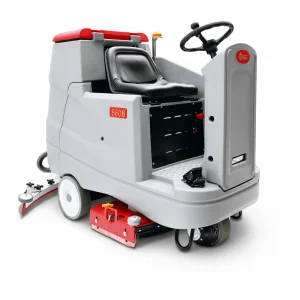
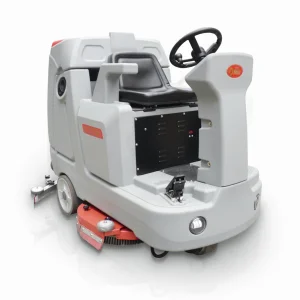
Addressing the complex operational demands across Victoria’s premier freight terminals, bulk handling centers, and advanced manufacturing precincts.
Greater Melbourne represents Australia's undisputed freight capital. The sprawling multi-hectare distribution footprints across Truganina, Ravenhall, Dandenong South, and Altona run 24/7 schedules. High-rack automated facilities demand pristine, dust-free burnished concrete floors to prevent tire slip, laser-guided AGV optical drift, and hazardous particulate contamination on stored palletized inventory.
Under WorkSafe Victoria guidelines, slip-and-fall incidents account for a significant share of industrial compensation claims. Modern ride-on scrubber dryers operating in Victorian facilities must deliver instantaneous water recovery. Surfaces must achieve a minimum wet Pendulum Test Value (PTV) immediately behind the trailing parabolic squeegee assembly to ensure uncompromising compliance with AS/NZS 4663 standards.
Continuous heavy counterbalanced forklift and reach-truck traffic inside cold-chain facilities and cross-docking warehouses leaves persistent black polyurethane and rubber burn marks. Maintaining concrete gloss and surface friction requires dual contra-rotating cylindrical or disc brush heads exerting variable down-pressures exceeding 80–120 kg coupled with targeted, metered enzymatic or alkaline solution dosing.
Strategic purchasing criteria utilized by tier-one supply chain operators, 3PL logistics corporations, and industrial facilities directors worldwide.
Forward-thinking procurement managers recognize that the upfront capital expenditure of a ride-on scrubber represents less than 22% of its lifecycle cost across a 5-to-7 year operational horizon. Labor efficiency dominates overall expenditure (upwards of 65%), while power, consumable brushes, squeegee blades, and routine maintenance comprise the remaining 13%. By migrating from pedestrian walk-behind scrubbers (1,800 m²/h coverage) to heavy-duty ride-on platforms (5,000–8,500 m²/h coverage), facility operators slash labor overhead by up to 68%, delivering amortized payback inside 9 to 14 months.
Traditional lead-acid AGM or flooded traction batteries introduce significant operational hazards: acid spills during equalization, dedicated ventilated battery charging bays to dissipate hydrogen off-gassing, and long 8-to-10 hour charging cycles. Modern enterprise-grade ride-on scrubbers feature integrated Lithium Iron Phosphate (LiFePO4) battery packs with proprietary Battery Management Systems (BMS). LiFePO4 chemistry supports opportunity fast charging during 30-minute shift breaks, extends cycle life beyond 3,500 charges at 80% DOD, and completely eliminates electrolyte maintenance overhead.
Enterprise procurement requires full fleet observability. Integrated CAN-bus telemetry transmits real-time telemetry datasets directly to cloud dashboards: monitoring active brush down-pressure, water consumption metrics, drive motor amp-draw, fault code diagnostics, and geographic impact telemetry. Facility supervisors obtain verifiable proof-of-clean records, scheduled preventive maintenance alerts, and operator key-card authorization to prevent unauthorized equipment operation.
Environmental, Social, and Governance (ESG) mandates require measurable reductions in potable water consumption and toxic chemical discharge into urban stormwater networks. Advanced ride-on scrubbers incorporate multi-stage solution micro-dosing systems, intelligent proportional flow control calibrated directly to machine ground speed, and closed-loop filtration options that recycle greywater for initial scrubbing passes, curbing chemical runoff and supporting carbon-neutral facility accreditations.
Optimized technical configurations engineered to resolve soil profiles across heavy industry, FMCG manufacturing, and cold storage.
Victoria's massive agricultural and beverage processing sector (concentrated in regional hubs and outer-metro corridors) requires adherence to strict HACCP sanitization protocols. Wet scrubbing in food processing environments requires seamless roto-molded anti-microbial poly tanks, high-grade 304/316 stainless steel hardware, and high-suction vacuum motors that ensure zero pooled liquid zones where listeria or bacteria could incubate.
Operating inside cold storage facilities maintained between -5°C and -28°C presents extreme mechanical friction challenges: standard squeegees freeze solid, battery discharge rates plummet, and recovery hoses become brittle and crack. Custom cold-pack scrubber configurations incorporate silicone squeegee compounds, insulated battery enclosures with active PTC self-heating elements, and low-temp synthetic hydraulic lubricants.
Machining and heavy metal fabrication environments across Clayton, Campbellfield, and Geelong battle sticky coolant mist, synthetic cutting fluids, and microscopic metallic dust. Cylindrical brush deck assemblies equipped with an integrated forward debris collection hopper sweep fine metal swarf while washing and scrubbing simultaneously, preventing abrasive particulates from tearing suction blades.
| Scrubber Class | Scrub Path (mm) | Max Theoretical Productivity | Solution/Recovery Capacity | Ideal Melbourne Facility Profile |
|---|---|---|---|---|
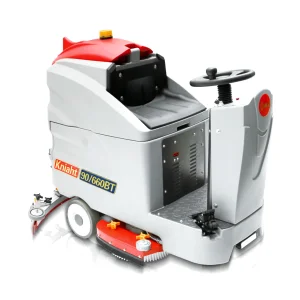
| Compact Ride-On (KNIAHT 90/660BT) | 660 mm | 3,960 m²/h | 90 L / 100 L | Commercial supermarkets, narrow aisle warehouses, light industrial assembly lines. |
| Mid-Capacity Ride-On (KNIAHT 860B) | 860 mm | 5,500 m²/h | 120 L / 130 L | Multi-tenant distribution hubs, parcel sorting facilities, retail shopping center malls. |
| Heavy Industrial Ride-On (KNIAHT 1020BT) | 1,020 mm | 6,800 m²/h | 160 L / 170 L | Multi-hectare port logistics, intermodal freight depots, heavy machinery manufacturing plants. |
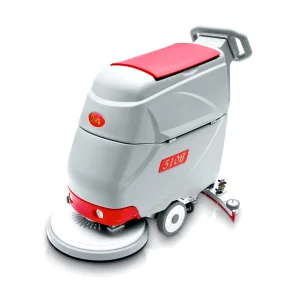
| Pedestrian Traction (Warrior 510B/BT) | 510 mm | 2,200 m²/h | 50 L / 55 L | Workshops, mezzanine platforms, localized staging bays, automotive service centers. |
Mapping the convergence of industrial automation, LiDAR navigation, and closed-loop ecological engineering in floor care machinery.
The transition from human-operated machinery to hybrid autonomous cleaning systems is accelerating across high-density facilities. Utilizing multi-line solid-state LiDAR, depth-sensing RGB-D cameras, and ultrasonic collision-avoidance sensors, modern autonomous scrubbers map complex warehouse layouts dynamically. They navigate active facilities safely alongside reach trucks, high-bay forklifts, and pedestrian pickers with sub-centimeter path-tracking accuracy.
Legacy scrubbing machines apply fixed spring down-pressure, resulting in premature brush wear on polished concrete or insufficient lifting power on greasy asphalt. Next-generation platforms integrate brushless DC actuators coupled with optical turbidity sensors. The machine reads real-time recovery water clarity, automatically increasing down-pressure from 40 kg to 110 kg and modifying flow volume only over severe grime zones.
To eliminate recurring surfactant expenditures and eradicate chemical residue slick risks, future engineering focuses on on-board electrolytic cell generation. Passing regular tap water across active electrodes transforms water into an active sanitizing solution (hypochlorous acid / micro-bubbles) that suspends oil and kills bacteria without requiring floor neutralization or leaving slippery surfactant residues.
Ensuring complete certification compliance with Australian safety authorities and zero operational downtime across the Greater Melbourne area.
All imported industrial charging platforms and internal wiring harnesses strictly conform to the Regulatory Compliance Mark (RCM) and AS/NZS 60335.2.72 standards. Industrial chargers feature indigenous Australian 3-pin 10A/15A plugs with integrated thermal overload safety cutoffs, RCD circuit compliance, and IPX4 water-ingress enclosures to safeguard facility operators during wash-down procedures.
Equipment downtime directly disrupts warehouse operations. Our strategic supply chain framework guarantees core consumable parts—including natural rubber squeegee blades, oil-resistant polyurethane blades, nylon disc brushes, Tynex grit-impregnated scrubbing brushes, drive motors, and suction solenoids—can be dispatched across metro Melbourne within 24 to 48 hours to minimize maintenance backlog.
Discharging dirty industrial recovery water into local storm drains is strictly prohibited under Environment Protection Authority (EPA) Victoria legislation. Our scrubbing platforms feature calibrated slow-drain valves and heavy-debris sediment separation baskets, permitting direct, safe draining into designated oil-water interceptors or industrial trade-waste collection tanks without splashing or clogging.
Key technical considerations evaluated by fleet managers, facilities directors, and industrial engineers prior to machine selection.
The primary sizing metric is total square meterage cleaned per shift and aisle width constraints. For facilities under 2,000 m² or layouts with tight mezzanine passages and narrow aisles (< 1.5 m), walk-behind units (such as the Warrior 510B) provide the necessary tight-radius agility. For warehouses exceeding 3,000 m², a ride-on machine (such as the KNIAHT 860B or 1020BT) is economically mandatory: it covers 3 to 4 times the area per hour, slashing cleaning shift duration from 6 hours down to under 2 hours.
Standard natural gum rubber squeegees offer high wiping elasticity on smooth, non-oily concrete, but they degrade and curl rapidly when exposed to motor oils, hydraulic fluids, or animal fats. For automotive service workshops, logistics terminals with forklift leaks, and food processing facilities, we specify oil-resistant Polyurethane (PU) squeegee blades. PU blades resist chemical softening, preventing streaking and maintaining continuous suction contact.
Excessive brush down-pressure on polished or densified concrete can strip protective lithium silicate densifiers and accelerate seal wear. Our ride-on units incorporate multi-stage electronically adjustable down-pressure controls. Operators can run at low pressure (30–45 kg) with soft polypropylene brushes for daily maintenance dust removal, or engage high down-pressure (80–110 kg) with abrasive poly-grit or Tynex brushes only on untreated, heavily soiled loading dock surfaces.
Yes. Our integrated high-frequency intelligent battery chargers are built with internal step-down transformers calibrated for Australian single-phase 230–240V / 50Hz electrical supplies. Depending on the machine battery capacity, chargers are supplied with either standard AS/NZS 3112 10-amp or heavy-duty 15-amp plugs, eliminating the need to install costly dedicated industrial 3-phase charging substations.
Explore our extended series of sweepers, high-pressure washers, extraction platforms, and specialized industrial vacuums designed for enterprise applications.