Explore our tier-one lineup of industrial floor scrubbers, continuous vacuum units, and municipal utility vehicles built for high duty-cycle operations.
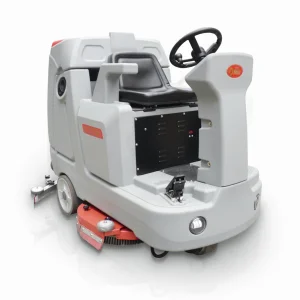
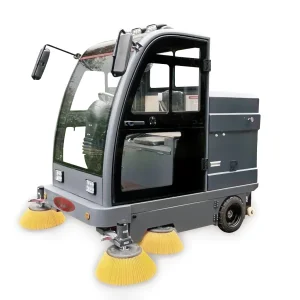
Analyzing the paradigm shift in international facility maintenance: How rising labor costs and stringent hygiene governance drive the adoption of walk-behind scrubbing automation.
Facility management operators face acute wage pressures and personnel shortages worldwide. Walk-behind scrubbers enable a single technician to achieve the clean floor square-footage output previously requiring a four-person crew.
OSHA, ISO 45001, and EN standards enforce strict dynamic coefficient of friction (DCOF) floor thresholds. Modern squeegee systems achieve immediate water extraction, eliminating slip hazards in active working zones.
Warehousing, precision engineering, and food processing mandate cross-contamination prevention. Closed-circuit clean/recovery tank systems capture suspended solids without atmospheric redeposition.
A breakdown of mechanical, fluid dynamics, and electrical powertrain subsystems designed for heavy duty-cycle commercial deployment.
The scrubbing subsystem relies on high-torque DC brush motors (550W–750W) paired with planetary gearboxes. Applying calibrated down-pressure (25kg to 45kg) ensures thorough dirt extraction without degrading delicate epoxy coatings, polished concrete micro-sealants, or PVC finishes. Self-leveling brush head skirts contain fluid splash within the working path.
Immediate drying is achieved through a multi-stage tangential vacuum motor (450W–600W, drawing 160–190 mbar depression) combined with a computer-modeled parabolic squeegee assembly. The aerodynamic curve directs greywater straight to the suction orifice, preventing side pooling during sharp 90-degree turning maneuvers.
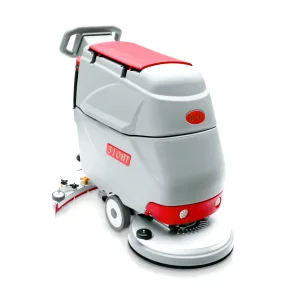
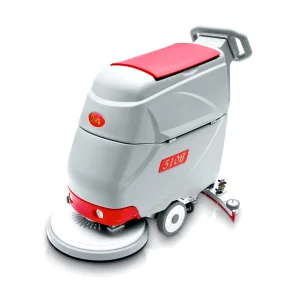
Industrial procurement balances two drive configurations: brush-assist drive (push propulsion facilitated by disc rotation for level floor setups) and integrated transaxle traction drive (such as Warrior 510BT, utilizing a 300W DC motor) capable of climbing ramps up to 8% gradient with zero operator physical strain.
Dual-tank architecture (isolated solution tank and recovery tank) manufactured with 6mm-thick rotomolded polyethylene resists industrial acids, oils, and chemical detergents. Smooth internal geometries prevent sludge build-up and facilitate rapid sanitization under HACCP facility guidelines.
| Scrubber Class | Scrub Width | Squeegee Width | Tank Capacity (Clean/Dirty) | Productivity Rate | Drive System |
|---|---|---|---|---|---|
| Compact Walk-Behind | 430 mm (17 in) | 720 mm | 35 L / 40 L | 1,500 – 1,800 m²/h | Pad Assist / Manual Push |
| Standard Commercial (Warrior 510B) | 510 mm (20 in) | 820 mm | 50 L / 55 L | 2,000 – 2,200 m²/h | Disc Rotation Assist |
| Heavy Self-Propelled (Warrior 510BT) | 510 mm (20 in) | 850 mm | 55 L / 60 L | 2,200 – 2,500 m²/h | Electric Transaxle Traction |
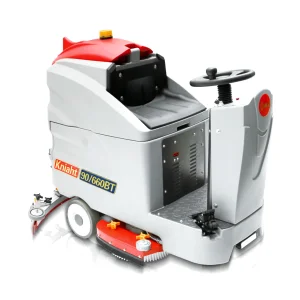
| Dual-Brush Walk-Behind | 660 mm (26 in) | 950 mm | 70 L / 75 L | 3,000 – 3,400 m²/h | Variable Speed Traction Drive |
Combining complete vertical component integration, agile OEM engineering, and automated testing rigs to produce reliable cleaning equipment with lower total cost of ownership.
We own and maintain the rotational tooling for all chassis, scrub heads, and tank bodies. This enables tight quality control, seamless mold iterations, and competitive unit pricing on wholesale contracts.
We build to CE, UL, RoHS, and CB safety architectures. Our power systems support 110V, 220V, and 240V grids with localized smart battery charging algorithms suited for both lead-acid and lithium packs.
Every unit undergoes a continuous 45-minute continuous run-in test: full hydrological hydraulic cycling, submerged seal verification, and electronic motor amp-draw load validation prior to export crate packing.
A cross-industry assessment of walk-behind scrubbers across specific flooring materials and contamination profiles.
Substrates: Terrazzo, polished tile, vinyl.
Challenge: Operating in tight, populated aisles during operational hours.
Solution: Low-decibel vacuum motors (<65 dB(A)) with immediate dry squeegees prevent slipping risks for foot traffic.
Substrates: Sealed industrial concrete, epoxy screeds.
Challenge: Forklift tire tire-mark scuffing and airborne packing dust.
Solution: Heavy-downpressure nylon grit brushes cut through tire rubber resins without dulling surface seals.
Substrates: Homogeneous conductive vinyl, ESD floors.
Challenge: Disinfection protocols, avoiding chemical aerosolization.
Solution: Chemical metering with sanitizing agents and non-marking polyurethane blades to maintain hygienic cleanroom conditions.
A systematic methodology for evaluating auto floor scrubber investments for distributors, facility contractors, and plant engineering heads.
| Evaluation Parameter | Deep-Cycle Lead-Acid (AGM/Gel) | Lithium Iron Phosphate (LiFePO4) | Strategic Procurement Impact |
|---|---|---|---|
| Cycle Life Expectancy | 400 – 600 Cycles (1.5 - 2 Years) | 2,000 – 3,000 Cycles (5 - 8 Years) | Lithium eliminates mid-lifecycle replacement costs and battery hazmat fees. |
| Opportunity Charging | Not Supported (Requires 8h recharge + cooling) | Supported (1h to 2h rapid top-up) | Enables continuous double-shift cleaning with a single walk-behind unit. |
| Maintenance Overhead | Periodic terminal inspection & cable torqueing | Zero maintenance (Integrated Smart BMS) | Cuts preventative maintenance downtime by over 30 labor hours annually. |
| Weight & Floor Impact | Higher weight ballast (approx. 50-70 kg) | 60% lighter battery mass | Reduces transaxle strain and power consumption per hour of run time. |
Anticipating the technological transitions defining commercial sanitation fleets through 2030 and beyond.
Modern commercial fleets increasingly adopt telemetry modules tracking operational run-hours, geographical location, battery depth of discharge, and squeegee wear reminders via cloud dashboards.
Eco-conscious operations utilize on-board electrolytic water oxygenation to break down oils without liquid surfactants—reducing ongoing chemical costs and discharge regulatory scrutiny.
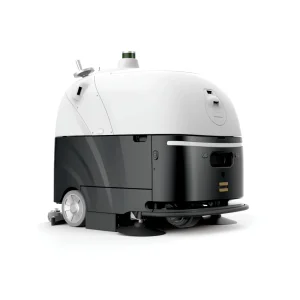
Industrial sites combine driverless autonomous units (like the SC80) on wide aisles with compact walk-behind units (such as the Warrior 510B) for tight corridors, optimizing fleet utility and capital expenditure.
Clear, practical answers directly from our factory engineering and international export divisions.
Broaden your cleaning operations with our specialized explosion-proof vacs, autonomous robotic scrubbers, and high-capacity sanitation transport systems.