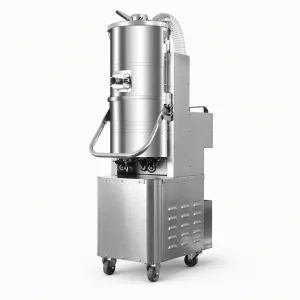
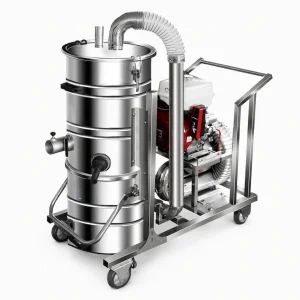
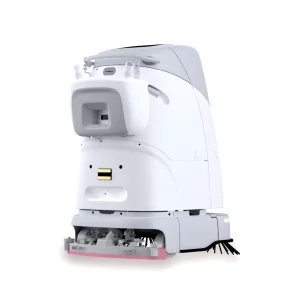
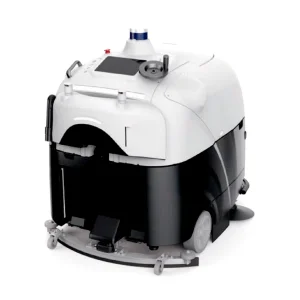
Direct manufacturer supply spanning three-phase reverse blow industrial vacuums, commercial ride-on scrubbers, and driverless automated scrubbing units.
A rigorous engineering assessment of modern mechanical floor care, shifting regulatory standards, and the operational transition toward high-uptime ride-on equipment.
Modern commercial facility management and heavy industrial manufacturing have reached a pivotal inflection point. Escalating labor shortages across the European Union, North America, and the Asia-Pacific region, coupled with aggressive workplace safety mandates, have rendered legacy manual mopping and walk-behind methods economically obsolete for footprints exceeding 3,000 square meters. As facilities expand vertically and horizontally, the commercial cleaning equipment sector has evolved from a basic sanitation function into an operational engineering science focused on hygiene validation, rapid return on investment (ROI), slip-and-fall mitigation, and floor asset preservation.
Global regulatory bodies—including OSHA (Occupational Safety and Health Administration) in the United States, EU-OSHA, and stringent cleanroom ISO 14644 classifications—now enforce rigorous particulate and slick-surface mitigation benchmarks. High-traffic commercial distribution centers, cold-storage logistics chains, automotive foundries, and pharmaceutical packaging plants demand industrial floor cleaning machinery capable of delivering sub-second surface drying, standardized chemical dosing, and consistent brush down-pressure. The wholesale procurement of ride-on floor scrubbers and heavy-duty sweepers has consequently shifted from decentralized single-unit acquisitions toward strategic fleet standardization backed by verified Tier-1 Original Equipment Manufacturers (OEMs).
In wholesale and commercial B2B environments, an enterprise's choice of ride-on floor scrubber directly dictates total operational overhead. When evaluated over a five-year lifecycle, labor represents roughly 70% to 80% of total floor maintenance expenditure, while machinery acquisition accounts for less than 15%. Implementing high-capacity ride-on scrubber dryers allows a single trained operator to complete what previously required four to six manual workers, drastically reducing organizational exposure to worker compensation claims caused by repetitive strain injuries while elevating the hygienic standard of the entire facility.
Vertical manufacturing integration, advanced rotational molding, and component standardization driving competitive advantages for global B2B distributors.
Tanks engineered via advanced seamless LLDPE rotational molding resist industrial acid-base chemical attack, impact fractures, and environmental stress cracking over ten years of continuous heavy-duty duty.
By producing proprietary DC permanent magnet brushless traction motors, sealed helical gearboxes, and automated CAN-bus wiring harnesses in-house, manufacturing variances are minimized while sustaining strict quality tolerances.
Each unit undergoes automated laser-guided chassis alignment verification, high-pressure water ingress IPX4-IPX5 containment evaluations, and continuous 120-minute dynamometer scrub endurance testing prior to container stuffing.
China's industrial cleaning equipment production hub—anchored in coastal manufacturing centers such as Wenzhou, Zhejiang—delivers unmatched supply chain resilience. Traditional Western manufacturing frameworks frequently suffer from multi-tiered sub-tier dependencies, where plastic tanks, squeegee castings, drive axles, and electronic controllers originate across disparate jurisdictions, generating lead times of 16 to 24 weeks. Conversely, DIKE's integrated manufacturing architecture unifies high-tonnage laser cutting, automated CNC chassis bending, robot-assisted argon-arc welding, polyurethane squeegee formulation, and multi-station assembly inside a single, vertically audited industrial complex.
This localized industrial concentration provides overseas wholesale distributors and engineering procurement contractors with structural commercial advantages. Engineering adaptations—such as customizing squeegee curvature for anti-slip epoxy profiles, reconfiguring dual-phase/three-phase vacuum blower voltages (220V/380V/415V/480V), or customizing private-label livery and dashboard firmware—can be prototyped, field-tested, and transitioned into volume manufacturing within four weeks. Furthermore, consolidated logistics ensure that replacement parts, squeegee replacement blades, brush assemblies, and replacement BMS modules can be co-shipped in 20GP or 40HQ containers without the supply-chain markups typical of layered intermediary networks.
An in-depth breakdown of mechanical fluidics, down-pressure kinematics, and acoustic mitigation systems engineered into commercial-grade scrubber dryers.
The core cleaning effectiveness of industrial ride-on scrubbers depends on the precise balance between brush rotational speed (RPM) and mechanical down-pressure. DIKE engineers utilize independent dual high-torque disc brush actuators or counter-rotating cylindrical scrub decks. While cylindrical systems are preferred for facilities with small debris (functioning as both a light sweeper and scrubber), disc scrub decks deliver between 45 kg to 95 kg of stabilized down-pressure. This mechanical pressure is critical for stripping polymerized tire marks from warehouse polished concrete without abrasive surface degradation.
In high-speed commercial environments, residual moisture behind an operating scrubber poses severe slip hazards and risks moisture ingress into adjacent stored corrugated packaging. DIKE machines feature aerodynamically modeled, parabolic die-cast aluminum squeegee assemblies. The parabolic arc creates a dynamic low-pressure vortex that draws dirty solution from the outer edges toward the center intake duct. Coupled with a three-stage 24V or 36V multi-fan vacuum motor insulated by double-walled sound baffles (achieving decibel levels under 65 dBA), water recovery exceeds 99.2% on standard industrial finishes, allowing foot and forklift traffic immediately after machine passage.
Traditional lead-acid and AGM (Absorbent Glass Mat) batteries present substantial operational challenges: heavy weight, toxic off-gassing during charging, long recharge cycles (8–10 hours), and high sensitivity to partial opportunity charging. DIKE ride-on floor scrubbers offer integrated high-rate LiFePO4 battery modules managed by an intelligent automotive-grade Battery Management System (BMS). LiFePO4 technology supports safe fast charging (0% to 100% in 2.5 hours), tolerates shift opportunity charges during worker breaks, and delivers over 3,000 full duty cycles before degrading to 80% capacity—outlasting standard lead-acid batteries fourfold.
How specialized engineering choices solve real-world maintenance challenges across industrial plants, logistics hubs, retail malls, and high-hygiene food processing facilities.
Primary Challenges: Airborne dust settling on high racks, abrasive rubber tire transfer from reach trucks, and vast aisle layouts.
Engineered Solution: Deploying the KNIAHT 1020BT series with large solution tanks (120L+), scrubbing paths up to 1020mm, and chemical-resistant polyurethane squeegees capable of processing 6,000+ m²/h without stopping for frequent tank refills.
Primary Challenges: Emulsified cutting oils, fine ferrous shavings, and heavy grease requiring aggressive chemical degreasers.
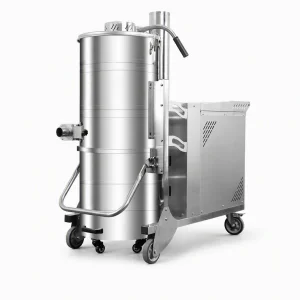
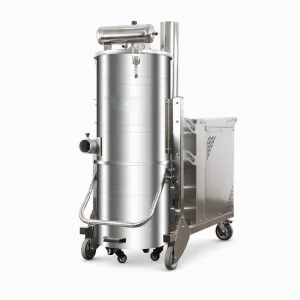
Engineered Solution: Combining three-phase industrial vacuum extractors (e.g., DIKE-221FC) for dry swarf removal with ride-on scrubbers utilizing high-tensile oil-resistant Linatex squeegee blades and nylon-grit composite brushes.
Primary Challenges: Strict HACCP sanitization mandates, biological contamination risks, and persistent humidity.
Engineered Solution: Machines equipped with smooth, anti-microbial rotomolded water tanks featuring full-access cleanout hatches, food-grade non-marking traction tires, and compatibility with non-foaming chlorine-based and quaternary sanitizing agents.
A reference procurement guide for distributor buyers, corporate facility executives, and project tender boards.
| Facility Dimension / Scenario | Primary Soil Challenge | Recommended Machine Configuration | Key Technical Selection Factors |
|---|---|---|---|
| Micro Retail & Narrow Clinics (< 1,500 m²) |
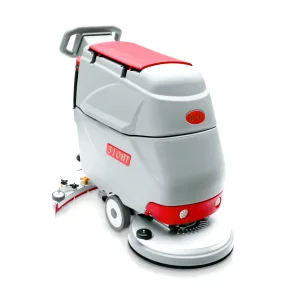
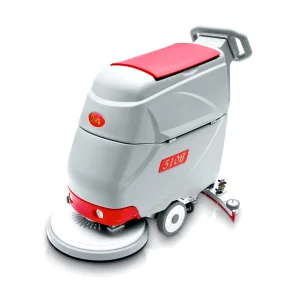
Light dust, tracked spills, tight corners | Warrior 510B / 510BT Walk-Behind Self-Propelled |
510mm cleaning width, turning radius < 850mm, noise emission < 62 dBA, standard 24V onboard charger. |
| Mid-Size Supermarkets & Showrooms (1,500 – 4,500 m²) |
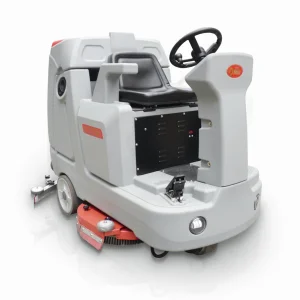
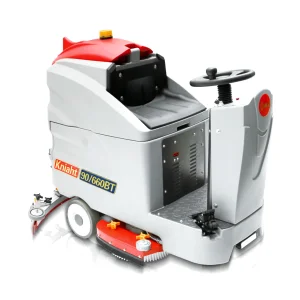
Shoe marks, high foot traffic, drink spills | KNIAHT 90/660BT Compact Ride-On Scrubber |
660mm twin-disc path, compact footprint fits standard passenger elevators, 90L solution capacity, ergonomic operator cabin. |
| Mega-Distribution & Logistics Hubs (5,000 – 30,000+ m²) |
Forklift tire skid marks, pallet dust, expansive routes | KNIAHT 1020BT Heavy-Duty Ride-On Scrubber |
1020mm scrub width, 120L+ capacity, 6,500 m²/h theoretical output, automatic speed governor on turn maneuvers. |
| Automated 24/7 Logistics Facilities (Repetitive Grid Paths) |
Constant micro-particulate buildup, low manual labor | SC50S / SC80S Driverless Autonomous Scrubbers |
LiDAR SLAM + 3D ToF obstacle avoidance, automated dock refill/drain cycle capability, cloud analytics monitoring. |
| Heavy Engineering & CNC Workshops (Oily Concrete Surfaces) |
Metal chips, coolants, heavy gear lubricants | DIKE-221FC (3-Phase Vacuum) + Ride-on Scrubber with Linatex |
Three-phase industrial continuous vacuuming to extract metal swarf, followed by high down-pressure scrubbing with oil-resistant squeegees. |
| Municipal Parks & Industrial Perimeters (Outdoor Mixed Trash) |
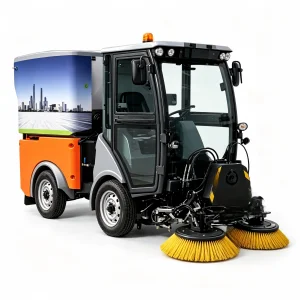
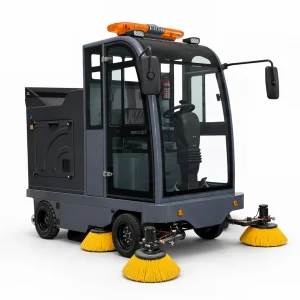
Sand, gravel, foliage, scattered packaging | DK-2000 / E-800 Enclosed Multi-Functional Sweepers |
Fully enclosed air-conditioned cab, side brush sweep width > 1800mm, high-pressure mist dust suppression, high-dump hopper. |
Experienced fleet procurement managers recognize that the initial equipment purchase cost represents only a fraction of total lifecycle expenditure. The comprehensive TCO over a standard 5-year operating window is calculated via:
By standardizing on DIKE's high-efficiency ride-on platforms, enterprises achieve payback periods under seven months when replacing manual crews. Consumable costs are substantially minimized thanks to standardized, tool-less squeegee flips (quad-edge reversible blades) and universal disc brush fittings, which protect commercial margins for distributors and contracted cleaning firms.
How cloud telemetry, real-time maintenance diagnostics, and cobotic systems are reshaping the future of automated facility hygiene.
Integrated 4G LTE/GPS IoT telemetry modules feed real-time battery health, motor thermal profiles, actual square-meter scrub coverage, and error diagnostic codes to centralized browser-based management portals.
Driverless scrubbers (SC50S/SC80S) work cooperatively alongside on-site personnel. While autonomous cobots tackle repetitive open warehouse floor routes during off-shift hours, staff focus on high-touch specialized detailing.
Next-generation on-machine continuous mechanical filtration systems capture suspended particulate matter from recovery water, extending wash cycle runtimes up to 300% on a single clean-water fill.
Authoritative answers covering global electrical standards, battery architectures, maintenance intervals, and OEM customization requirements.
Explore our heavy sanitation vehicles, continuous reverse-pulse vacuums, and high-pressure washing systems engineered for diverse facility challenges.