Direct-from-factory catalog specifications engineered for large logistics centers, hazardous dust recovery, municipal hygiene, and high-intensity production floors.
Modern industrial environmental regulations, including OSHA respirable crystalline silica standards and European ATEX directives, demand a transition from manual dry sweeping to vacuum-assisted, sealed sweeper architecture.
Traditional rotary brooms without active negative-pressure extraction suspend up to 68% of respirable PM2.5 and PM10 particles into the operator's breathing zone. DIKE push vacuum sweepers incorporate sealed vacuum shrouds with localized air curtains, capturing sub-micron particulate directly at the brush interface before airborne dispersal occurs.
Labor costs comprise approximately 78% to 84% of total facility sanitation budgets. Implementing walk-behind push vacuum sweepers elevates surface cleaning velocity from an average of 450 m²/hour (manual broom) to 2,800–4,200 m²/hour, compressing operational labor costs by over 74% across a standardized 3-year depreciation window.
Unlike commercial-grade domestic plastic sweepers, DIKE wholesale units utilize rotational-molded high-density polyethylene (HDPE) polymer chassis paired with powder-coated structural steel cross-members, providing impact resistance in heavy forklift corridors and high-throughput warehousing terminals.
An examination of pneumatic engineering, multi-stage HEPA filtration, brush kinematics, and battery management systems implemented inside DIKE wholesale industrial machinery.
| Subsystem | Engineering Specification | Operational Function | Wholesale Advantage |
|---|---|---|---|
| Aerodynamic Impeller | Dynamic balanced aluminum alloy radial turbine; 2,800–3,400 RPM | Generates 180–320 m³/h volumetric suction airflow at >18 kPa vacuum lift | Prevents cavitation; withstands abrasive grit impact without blade deformation |
| Primary Filtration | PTFE-coated polyester needle felt cartridges; M-Class rating (0.2–2.0 micron) | Extracts heavy particulate dust while resisting oil-mist saturation | Washable lifespan >1,800 operational hours; lowers consumable turnover |
| Secondary Exhaust (HEPA) | Certified H13 / H14 micro-fiberglass media; EN 1822 standard (99.97% @ 0.3μm) | Prevents downstream emissions; ensures ISO Class 7/8 cleanroom compatibility | Critical for pharmaceutical, food production, and battery manufacturing facilities |
| Filter Cleaning System | Integrated electromagnetic shaker or pneumatic reverse-blow pulse system | Dislodges caked dust from filter pleats without disassembling the housing | Maintains continuous operational airflow; avoids operator manual intervention |
| Brush Kinematics | Counter-rotating chevron cylindrical main brush + twin articulating side brooms | Flings heavy debris directly into hopper while sweeping edges and baseboards | Tool-free quick-release brush core; adjustable down-force calibration (5–25 kg) |
| Drive & Battery System | 24V/48V maintenance-free AGM deep-cycle or optional LiFePO4 battery pack with CAN-BMS | Provides 3.5 to 5.5 hours continuous runtime per charge cycle | Over-discharge, short-circuit, and thermal runaway protection integrated into controller |
DIKE engineering teams utilize Computational Fluid Dynamics (CFD) modeling to analyze internal plenum turbulence. In traditional square-chassis sweepers, boundary layer vortices create dead zones where heavy particulate falls out of the air stream before reaching the collection hopper. DIKE push sweepers utilize a tapered venturi throat design, accelerating intake velocities to 24 m/s. This allows metallic turnings, dry cement debris, glass fragments, and plastic pellets to be entrained directly into the main hopper without clogging the ductwork.
Industrial walk-behind sweepers must accommodate operator diversity across global markets. Our push sweeper chassis incorporates an adjustable, vibration-isolated handlebar featuring dual soft-touch emergency stops, intuitive turtle/rabbit speed selectors, and clear LED diagnostic telemetry. Self-propelled models utilize an electronic differential with regenerative braking, enabling safe operation on 15% gradient ramps in multi-level parking decks and loading docks.
How DIKE push vacuum sweepers, explosion-proof units, and heavy ride-ons are configured for varying floor substrates, contaminants, and facility microclimates.
Primary Contaminants: Cast iron turnings, stamping scrap, coolants, hydraulic oil film, graphite residue.
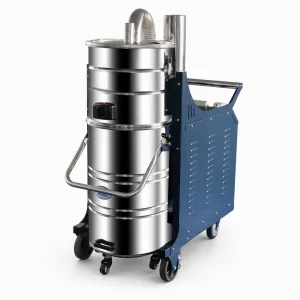
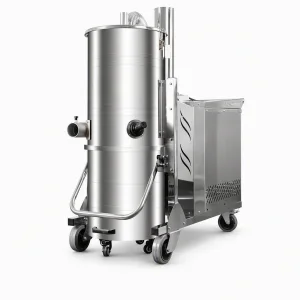
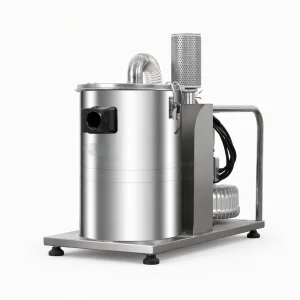
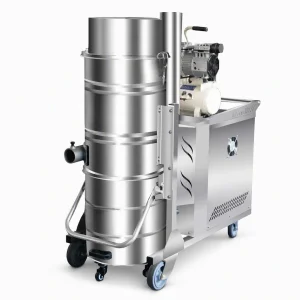
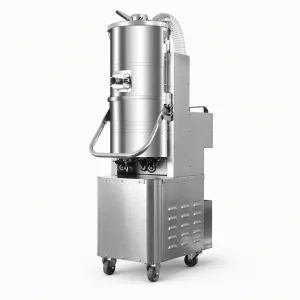
Standard soft-bristle sweepers wrap curly metallic turnings around their axles, causing bearing seizure. In contrast, DIKE units deploy oil-resistant poly-crimped wire composite brushes paired with steel debris flaps. The twin-tank industrial vacuum cleaners (e.g., DK-2290SE) integrate stainless steel cyclone diverters to separate cutting fluids from dry turnings in a single pass.
Primary Contaminants: Wooden pallet splinters, shrink-wrap strips, corrugated fiberboard dust, tyre rubber dust.
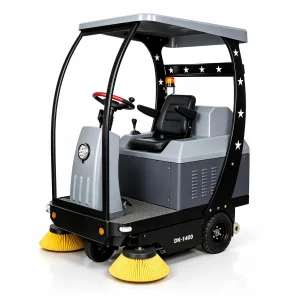
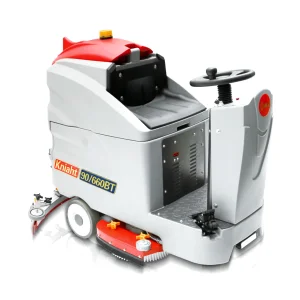
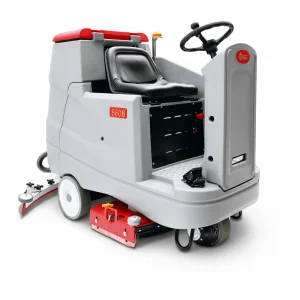
High rack facilities cannot tolerate airborne dust settling on packaged goods. Walk-behind push vacuum sweepers paired with wide-path ride-ons (like the KNIAHT 1020BT or DK-1400) provide 100% path coverage. Articulated floating side brooms sweep flush against baseboards and rack legs, capturing fine silica and rubber particulate into sealed hoppers.
Primary Contaminants: Active pharmaceutical ingredients (API), graphite-lithium electrode powders, explosive flour/starch dust.
Deploying standard motors in combustible environments creates ignition risks. DIKE delivers certified ATEX-compliant explosion-proof three-phase vacuum machines (e.g., DK-EX) and specialized pharma units (e.g., DK-1535Y) equipped with antistatic conductive ground paths, spark-free blowers, and certified HEPA downstream containment.
| Facility Category | Floor Substrate | Recommended Primary Machine | Complementary Equipment | Standard Shift Productivity |
|---|---|---|---|---|
| Narrow Distribution Corridors | Polished Concrete / Hardened Screed | Walk-Behind Push Vacuum Sweeper | DK-221MFC Pulse Reverse Vacuum | 12,000–18,000 m² / shift |
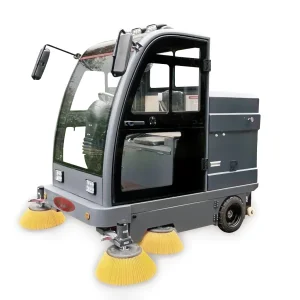
| Heavy Foundry & Metal Stamping | Rough Steel-Troweled Concrete / Asphalt | DK-1800 Fully Enclosed Sweeper | DK-EX Explosion-Proof Vacuum | 35,000–50,000 m² / shift |
| Semiconductor & Clean Workshops | Conductive ESD Epoxy Resin | KNIAHT 860B Floor Scrubber | DK-1535Y Pharmaceutical Vacuum | 15,000–22,000 m² / shift |
| Municipal Pedestrian Plazas & Parks | Granite Pavers / Permeable Asphalt | DK-1400 Semi-Enclosed Sweeper | LB3CX600 High-Pressure Washer | 25,000–38,000 m² / shift |
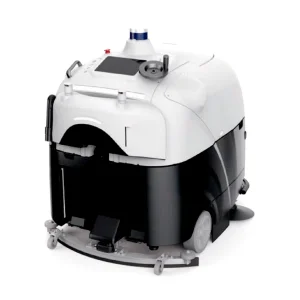
| Commercial Malls & Transit Hubs | Terrazzo / Glazed Ceramic Tile | SC80S Driverless Autonomous Scrubber | DIKE-510BT Hand-Pushed Scrubber | 20,000–30,000 m² / shift |
How DIKE partners with global equipment importers, private-label distributors, and municipal contracting authorities to streamline customs clearance and post-sale technical maintenance.
All DIKE export equipment is engineered to fulfill destination country mandates. We maintain active compliance documentation for the European CE Machinery Directive (2006/42/EC), Low Voltage Directive (LVD), Electromagnetic Compatibility (EMC), RoHS, and North American UL/CSA electrical standard alignments.
Global power grids diverge significantly across continents. DIKE builds customized charging systems and single/three-phase motors accommodating 110V/60Hz, 220–240V/50Hz, 380V–415V/50Hz, and 480V/60Hz configurations. We supply regional plug standards (NEMA, Schuko, UK Type G, BS 546) directly installed from our Wenzhou assembly lines.
To optimize import tariffs and ocean freight container utilization, DIKE provides Semi-Knocked-Down (SKD) and Completely-Knocked-Down (CKD) packing systems with comprehensive video assembly guides. Furthermore, we establish consignment spare parts packages (brushes, squeegee blades, suction hoses, gaskets, solenoids) ensuring 98% distributor inventory availability.
Strategic research and development milestones transitioning industrial cleaning equipment from mechanical push tools into connected, data-driven environmental management assets.
Integrated 4G/5G telematics modules communicate motor winding temperatures, differential filter pressure drops, brush downforce amperages, and GPS/WiFi positioning to a centralized fleet dashboard. Facility managers receive automated maintenance alerts before bearing failures or vacuum motor burnouts occur.
Replacing traditional lead-acid weight with high-energy-density LiFePO4 and emerging quasi-solid-state cells. The architecture features ultra-fast 1C-rate opportunity charging, allowing a push vacuum sweeper to absorb a 40% battery charge boost during a 30-minute operator meal break, enabling non-stop 24/7 multi-shift logistics operation.
Evolving from our flagship driverless series (such as the SC80S), future push vacuum sweepers will integrate dual-mode operational firmware. Machines operate as ergonomic manual walk-behinds in complex, dynamic workstations, but switch via one click to autonomous SLAM-LiDAR guidance for long, repetitive warehouse corridors.
Key engineering, shipping, MOQ, and technical differences addressed by DIKE factory specialists for global equipment wholesalers and operations executives.
A push vacuum sweeper is engineered for dry particulate recovery (sand, cement dust, wood chips, metal swarf, dry leaves) using mechanical brooms combined with negative-pressure air filtration. A floor scrubber dryer (e.g., KNIAHT series) requires clean water and detergent to scrub hard surfaces with liquid solution, followed by squeegee vacuum recovery. Attempting to scrub floors covered with heavy loose debris damages scrubber squeegees; facilities with heavy debris should first run a push vacuum sweeper before wet scrubbing.
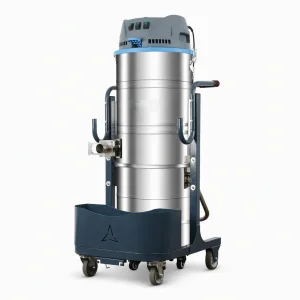
Single-phase industrial vacuums use brush commutator motors suited for intermittent cleaning cycles (1 to 2 hours continuously) on standard 110V or 230V outlets. Three-phase units (such as the DK-EX or DK-2203G) employ brushless induction side-channel blowers engineered for 24/7 continuous duty cycles without overheating, making them mandatory for central vacuum piping systems, high-density bulk material conveyance, and foundry extraction.
In machines like the DK-221MFC, the filtration chamber contains a dedicated solenoid pulse valve connected to an internal or external compressed air source. At pre-calibrated intervals (or triggered by differential pressure sensors), the valve releases a 0.2-second burst of 6-bar compressed air in reverse direction through the core of the PTFE cartridge. This micro-shockwave flexes the filter pleats outward, dislodging the dust cake directly into the hopper without stopping the main vacuum suction.
Standard catalog configurations carry a flexible MOQ of 2 to 5 units for distributor sample evaluation. For full OEM private labeling (customized Pantone chassis colors, silkscreen brand graphics, tailored user interfaces, and localized language packaging), our factory MOQ is typically 1 x 20GP container (approx. 12 to 24 units depending on model volume). Production lead time spans 18 to 28 business days from engineering sign-off.
Yes. Our explosion-proof three-phase series (including the DK-EX series) is engineered in strict accordance with ATEX Directive 2014/34/EU and IECEx international standards. Each machine is delivered with complete compliance documentation, third-party laboratory test certificates, antistatic continuity validation sheets, and IP65 motor certification for combustible dust environments (Class II, Div 1/2 in North America).
DIKE maintains standardized, backward-compatible modular consumable specifications across machine generations. Distributors can order pre-packaged Annual Maintenance Service Kits containing matched sets of main cylindrical brushes, side brooms, drive belts, filter elements, and castor wheels. All critical wear items are cataloged with universal CAD exploded part numbers for swift reordering.
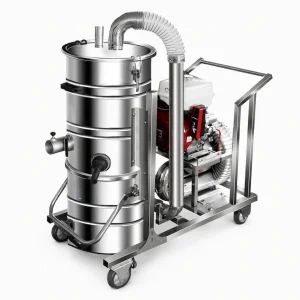
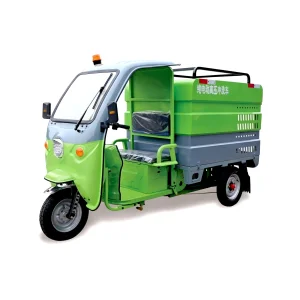
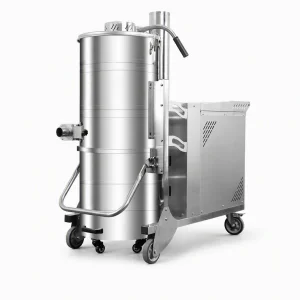
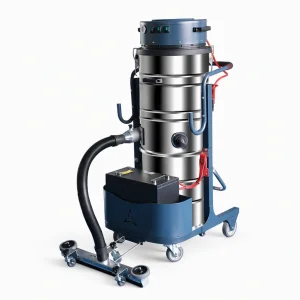
Browse our extended industrial fleet: Autonomous scrubbers, cordless lithium-ion units, gasoline-powered off-grid extractors, and municipal washing tricycles.
Connect directly with DIKE application engineers in Wenzhou, China. Provide your target floor substrate, total area per shift, voltage specifications, and anticipated wholesale order volume for a complete technical configuration and distributor pricing schedule.