Ride-on floor scrubbers are becoming practical assets for large facilities, where wide aisles and long shifts make manual cleaning difficult. A single machine can scrub, recover water, and leave a damp floor nearly dry in one pass. That matters in warehouses, airports, shopping centers, and factories. It also makes machine choice more consequential.
Grand View Research estimated the global commercial cleaning equipment market at USD 11.65 billion in 2023, with continued growth projected through 2030. This figure covers more than ride-on scrubbers, so it should not be mistaken for their standalone market size. Still, it signals sustained investment in mechanized cleaning. ISSA’s former executive director, John Barrett, has described cleaning as “an investment in human health, the environment, and an improved bottom line.” The point is relevant here: a scrubber’s value depends on more than its purchase price. Water use, battery life, operator visibility, service access, and parts availability shape daily performance.
This guide examines China’s top 10 Ride On Floor Scrubber manufacturers, with attention to product range, manufacturing capability, and support. Specifications deserve careful checking. A large tank does not guarantee better productivity, and a low price can hide service costs. No ranking is perfect. Buyer needs differ, and published market data rarely separates ride-on models cleanly. Treat this list as a starting point, then verify capacity, warranty terms, and local service before choosing a supplier.
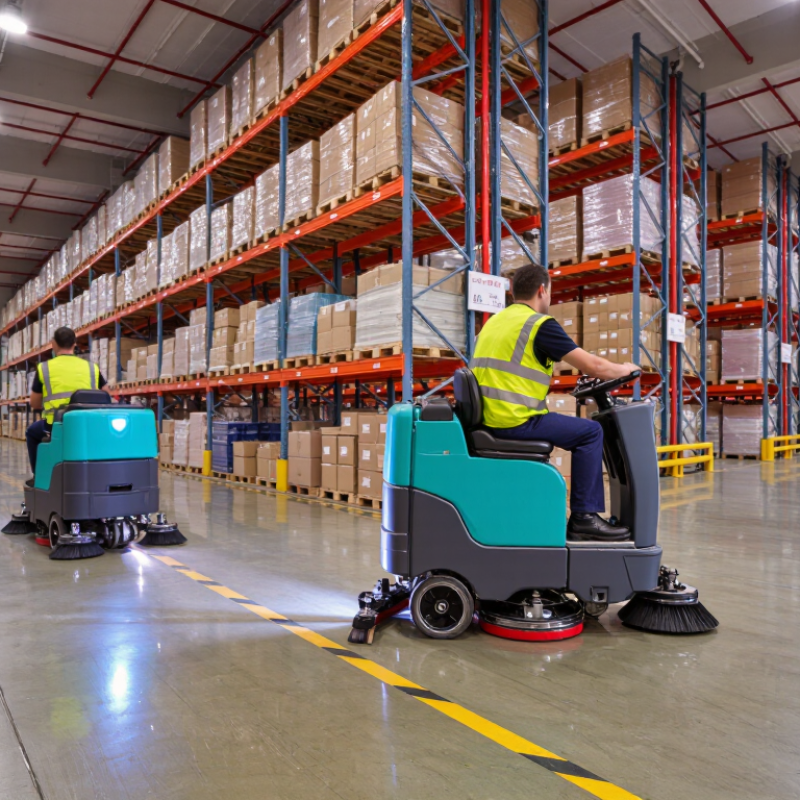
A ride-on floor scrubber combines solution tanks, rotating brushes or pads, and a rear squeegee with a vacuum. Clean water and detergent reach the floor; the brushes loosen soil, then the squeegee collects dirty water into a recovery tank. The operator steers from a seated position, controlling speed and water flow. On a wide warehouse aisle, that means fewer walking passes and less lingering wash water—not a guarantee of a dry, safe floor.
Capacity figures need context. For example, a machine with a 0.8-meter cleaning path moving at 4 kilometers per hour has a theoretical rate of 3,200 square meters per hour. Turns, overlap, obstacles, and refills reduce actual output. ISSA’s Cleaning Industry Management Standard (CIMS) emphasizes documented processes and measurable results; operators can log cleaned area, water use, and downtime to compare real shifts. The calculation looks neat. The floor rarely is.
Tips: Sweep grit first to protect pads and brushes. Match detergent and pad to the surface, and test a small area. Check the squeegee blades when water trails remain. Record the settings; teams sometimes forget what worked.
A practical overview of ten key machine features and cleaning stages. Typical configurations vary by model, floor type, and application; this table is not a manufacturer ranking.
| No. | Feature or Stage | Typical Configuration or Data | How It Works and Why It Matters |
|---|---|---|---|
| 1 | Ride-on design | Operator seat, steering controls, and powered drive | The operator rides on the machine and steers it across the floor. This layout is intended for larger areas where walking behind a scrubber would take longer. |
| 2 | Cleaning path | Width depends on the model; commercial ride-on units commonly use a path of roughly 20–40 in (about 500–1,000 mm). | The cleaning path is the width covered in one pass. A wider path can cover open areas faster, while a narrower machine may be easier to maneuver in tighter spaces. |
| 3 | Solution tank | Holds clean water and, where required, diluted floor-cleaning solution; tank capacities vary substantially by machine size. | A pump or gravity-fed system delivers solution to the brushes or pads. Correct dilution and using a floor-compatible detergent are important for effective cleaning. |
| 4 | Brushes or pads | Usually one or more rotating disc brushes or cylindrical brushes; pad type and brush material depend on the floor and task. | Rotation agitates the floor and loosens soil. Disc systems apply cleaning action across a flat path; cylindrical systems use rotating rollers and can also collect some small debris. |
| 5 | Brush pressure | Pressure is set by the machine design and may be adjustable on some models. | Brush contact helps remove soil, but more pressure is not always better. Excessive pressure or an unsuitable pad can damage some floor finishes. |
| 6 | Traction and speed | Battery-powered drive is common; travel and cleaning speeds are model-specific. | The drive motor moves the scrubber, while the operator controls direction and speed. Slower operation may be needed for heavy soil, turns, or congested areas. |
| 7 | Vacuum recovery | A vacuum motor draws recovered liquid into the recovery tank through a hose and squeegee assembly. | After the brushes scrub the floor, suction collects dirty solution rather than leaving it on the surface. Filters and hoses need regular inspection to maintain airflow. |
| 8 | Squeegee assembly | A floor-contacting blade assembly is mounted behind the scrub deck; blade shape and width vary by model. | The squeegee channels liquid toward the suction inlet. Clean, correctly installed blades help reduce streaks and leftover water. |
| 9 | Power and runtime | Rechargeable batteries power the drive, brushes, and vacuum system; battery voltage, capacity, and runtime are model-specific. | Actual operating time depends on battery condition, floor conditions, settings, and how the machine is used. Follow the machine manual for charging and battery maintenance. |
| 10 | Best-fit applications | Common settings include warehouses, factories, retail facilities, airports, and other broad hard-floor areas. | Ride-on scrubbers are generally most useful where there is enough open floor space to justify their size. Check turning space, floor type, access routes, and cleaning requirements before choosing a machine. |
Operating sequence: Dispense solution, agitate the floor with brushes or pads, then collect the dirty liquid with the squeegee and vacuum system. Always follow the equipment manual and the floor-care instructions for the site.
Machines have shifted from basic mechanical controls toward traction drives, onboard chargers, and clearer displays. Component quality still varies.
No. Manufacturing value added rose 5.0% in 2023, but that figure does not measure scrubber output. It only reflects the wider production base.
China installed 276,288 industrial robots in 2023, according to an industry report. That supports a broader automation ecosystem, not scrubber-specific output. The distinction matters.
Request a live test on your actual floor. Check recovery after a tight turn, and ask for recent quality-control records and service documents.
Compare cleaning width, speed, tank capacity, runtime, noise, and recovery rate. Ask about test conditions; figures without context can mislead.
Wide brush decks can suit open warehouses, while tight turning helps in supermarket aisles. Hotels may value quiet operation and quick turnaround. No single specification fits every site.
Time a full route, inspect dried corners, and note refilling frequency. Check visibility around racks and controls after an hour. Small details count.
Ask for spare-parts lists, manuals, operator training, warranty terms, and realistic response times. A low quote may hide downtime. Still, even a careful checklist misses things.
This article introduces the Ride On Floor Scrubber and explains how its combination of powered brushes, cleaning solution, and water recovery helps maintain large floor areas efficiently. It also looks at the development of China’s ride-on scrubber industry, including the growing emphasis on manufacturing capability, product variety, and practical design. Readers will find a clear framework for evaluating manufacturers, considering factors such as build quality, cleaning performance, ease of maintenance, customization options, and after-sales support.
The article profiles ten leading Chinese manufacturers without focusing on brand promotion, then outlines how to compare their products and services for different settings, from warehouses and factories to commercial buildings. By matching machine capacity, maneuverability, operating time, and service coverage to a facility’s needs, buyers can make a more informed choice and identify a suitable solution for their floor-cleaning requirements.