No source articles were included, so I can’t verify industry report figures or a named expert’s exact words. I shouldn’t invent citations or attribute a fabricated quote. Please provide the articles or the expert and report sources you want cited.
How to Choose the Best Ride On Floor Sweeper?
Identify Your Cleaning Needs and Facility Conditions
Start with the mess, not the machine. Fine dust in a warehouse needs different pickup than leaves, paper scraps, or scattered packaging. Note how much debris appears each shift and how often floors need cleaning. A few minutes of observation can reveal busy zones, such as loading bays and aisle ends. Dust changes everything. Also check the floor surface. Smooth concrete, textured flooring, and uneven outdoor paths can affect sweeping performance and operator comfort.
Tips: Measure your narrowest aisle and doorway before comparing machine dimensions. Check turning space around racks, floor slopes, thresholds, and overhead clearance. Record daily cleaning hours, debris volume, and whether dust control is important. Small details matter.
Then match the machine’s working width, collection capacity, and runtime to those conditions. A wider cleaning path may cover open floors faster, but it can be awkward among close-set shelves. A larger debris hopper can reduce emptying stops, though it may add bulk. Consider where the sweeper will be stored and charged, too. In practice, facility needs are not always neat on paper; one site may combine narrow indoor aisles with a rough exterior entrance. Walk the route with a tape measure, and ask operators which corners or spills are repeatedly missed. Their feedback can challenge your first estimate.
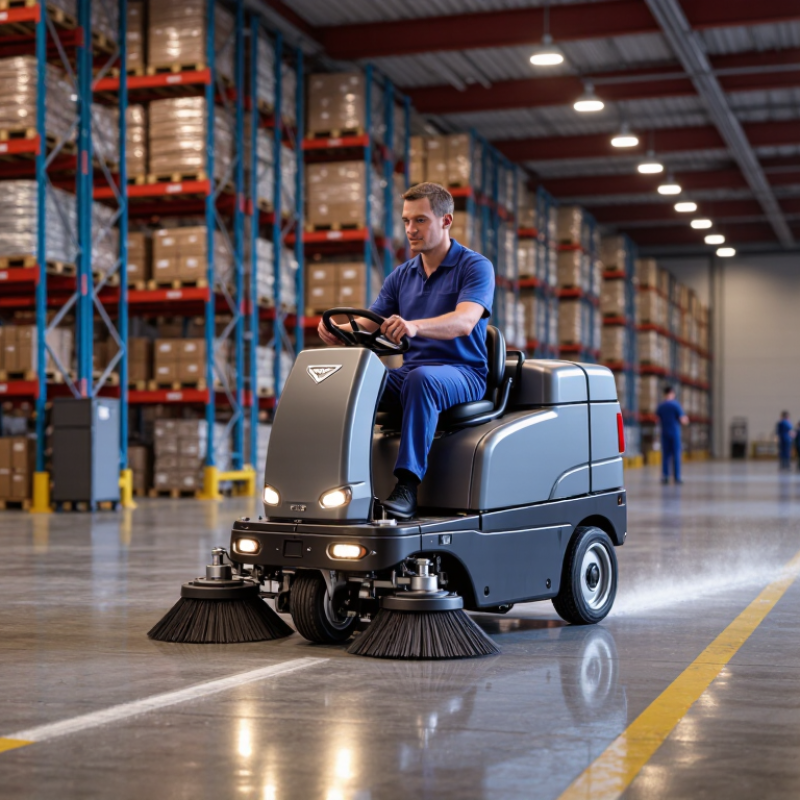
Ride-on floor sweepers differ in size, brush layout, and debris capacity. Compact seated models maneuver through warehouse aisles, while larger machines cover open floors faster. Cylindrical brushes handle heavier debris; side brushes reach edges and corners. Check hopper capacity and filter access, not just the advertised cleaning width. A wide machine may struggle around pallet racks. Dust control matters.
Battery-electric models suit many indoor sites because they produce no exhaust at the point of use. Their shift length depends on battery capacity, floor conditions, and charging breaks. Fuel-powered options can support long outdoor shifts, but require suitable ventilation and regular engine care. Noise matters. Compare energy costs, charging or refueling access, and real daily runtime before deciding.
Tips: Measure the narrowest doorway and turning space. Ask operators to test the sweeper on typical debris, such as grit near loading doors. Leave time for charging or refueling in the work schedule. Specifications can look convincing; a floor trial may still reveal a mismatch.
Compare ride-on sweeper power options by their direct CO₂ emissions per unit of energy consumed.
What this means: Battery-electric sweepers produce no tailpipe CO₂ during operation. Gasoline and diesel figures show CO₂ released when fuel is burned, divided by the fuel’s energy content. These figures do not account for electricity generation, fuel production, or machine efficiency, so consider charging access, operating hours, and ventilation needs when choosing a sweeper.
Sources: U.S. EPA fuel combustion emission factors; U.S. EIA fuel heat-content data. Values are approximate.
When comparing ride-on floor sweepers, look beyond hopper size. A larger bin can reduce dump stops, but it also adds weight and may make tight turns harder. Check the stated cleaning width and travel speed, then compare them with your actual route. A useful estimate is width × speed × working time; walls, pallet corners, and repeated passes lower real coverage. Test the machine on a dusty aisle, not an empty showroom floor. It may surprise you.
Maneuverability matters most where traffic and obstacles meet. Watch the rear swing near racks, and check whether the operator can see floor edges while seated. A tight turning radius helps, but only if controls feel steady and intuitive. Small details count. Ask operators to try a doorway and a loaded aisle; their feedback may contradict the specification sheet.
Filtration deserves equal scrutiny, especially where fine dust settles on shelves or returns to the air. The U.S. EPA’s HEPA guidance sets a benchmark of 99.97% particle capture at 0.3 microns. That figure describes HEPA performance, not every sweeper filter. Ask for the filter class, cleaning method, and replacement interval, then check how dust is contained during hopper emptying. A strong filter can still disappoint if seals leak. The EPA figure is useful, but it does not replace testing under your site’s conditions.
A ride-on floor sweeper should feel predictable before it feels fast. Check that the operator can see the brush edges, nearby shelves, and floor transitions from the seated position. Test the seat adjustment, steering effort, pedals, and access to the controls. A clear emergency stop and audible warning should be easy to locate and use. If the machine feels awkward during a short trial, a longer shift will not make it better. Small comfort issues matter.
Maintenance needs shape daily reliability. Look for brush and filter access that does not require awkward lifting, and check how dust bins are removed and emptied. Ask what routine checks the operator can perform, such as inspecting brushes, clearing debris, and checking battery charge or fuel levels. Follow the service schedule in the operator manual; maintenance intervals vary by machine and working conditions. A checklist helps, though people may still miss a blocked filter on a rushed shift. Review how quickly common wear parts can be inspected, and whether the storage area has room for safe servicing.
How to Choose the Best Ride On Floor Sweeper?
Compare Total Ownership Costs and Service Support
A sweeper’s purchase price is only the starting point. Estimate the full cost over several years, including batteries, brushes, filters, tires, and routine labor. Ask how often each part typically needs replacement under conditions similar to yours. A dusty warehouse and a smooth retail floor can wear equipment differently.
Service support matters when a machine stops mid-shift. Check the provider’s response times, technician availability, and access to common replacement parts. Ask what maintenance your own staff can safely handle, and what requires a trained technician. Clear answers are more useful than broad promises. Request a sample maintenance schedule and a written breakdown of warranty coverage.
Put the figures beside your expected hours of use. A lower-priced sweeper may cost more if repairs take days or parts must travel far. Consider battery charging time, too; a machine that cannot cover a full shift may require schedule changes. Test the sweeper on your actual floor, if possible, and note visibility, turning space, and debris pickup. Some costs are hard to predict. That is worth admitting. Keep a small allowance for unexpected repairs, and compare support plans before making your choice.
Note debris type, daily volume, cleaning hours, and floor surfaces. Measure the narrowest aisle, doorway, thresholds, slopes, and overhead clearance. Small details matter.
A wide path can cover open concrete quickly, but may feel awkward between close-set racks. A larger hopper means fewer emptying stops, though it adds bulk. Balance both against your route and storage space.
Multiply working width by travel speed and available cleaning time. Walls, pallet corners, obstacles, and repeat passes reduce that estimate. Test a dusty aisle, not an empty showroom. Paper estimates can be wrong.
Check turning space, rear swing, seated visibility, and control feel near racks. Have operators try a doorway and a loaded aisle. Their feedback may challenge the specification sheet.
Ask for the filter class, cleaning method, and replacement interval. Check whether dust escapes when emptying the hopper, and inspect the seals. A strong filter can still disappoint.
It is a HEPA performance benchmark for capturing particles at 0.3 microns. It does not describe every sweeper filter or guarantee results in your facility. Test under real conditions.
Include batteries, brushes, filters, tires, routine labor, and likely repairs over several years. Compare replacement frequency under similar floor and dust conditions. Leave room for surprises.
Ask about response times, technician availability, replacement parts, warranty coverage, and maintenance your staff can safely handle. Check battery charging time against your shift. Some costs remain uncertain. Admit that, and plan for it.
Choosing the best Ride On Floor Sweeper starts with understanding the facility: consider floor types, debris, cleaning frequency, aisle widths, and any site-specific conditions. Compare sweeper designs and power options to find a machine suited to the working environment and available charging or refueling arrangements. Look beyond headline specifications by evaluating cleaning capacity, maneuverability, dust filtration, and the ability to reach around obstacles or into tighter spaces.
Operator safety, comfort, and ease of maintenance also matter for reliable daily use. Check visibility, controls, seating, access for routine servicing, and the availability of replacement parts and support. Finally, compare total ownership costs, including purchase price, energy or fuel, upkeep, and expected service needs. Weighing these factors together helps identify a sweeper that fits the facility’s requirements and supports efficient, consistent cleaning over time.